Guide · Mexican food
Mexican Food: What It Is and Where Each Dish Comes From
Corn, beans and chile came first, and UNESCO still calls them the base. Pork, beef, wheat and rice came by boat after 1519, and each region did its own thing with the mix. Below: what's what, and where the American version takes over.
In 2010 UNESCO put traditional Mexican cuisine on its list of intangible cultural heritage. Its description starts with the farming, and the line that matters is short: "the basis of the system is founded on corn, beans and chili." The listing also names nixtamalization, the old step of cooking corn with lime, which makes it more nutritious and is what turns it into tortilla dough.
What was already here, and what came later?
This is the fastest way to understand the food. The first column is what Mexico had for thousands of years. The second is what showed up after the Spanish did in 1519.
Already here
- CornMexico is its cradle, even if the exact valley is still argued over
- BeansDomesticated in Mesoamerica about 7,000 years ago
- ChileOne of the three staples UNESCO names
- TomatoNative, on UNESCO's list
- SquashNative, on UNESCO's list
- AvocadoFrom the highlands of Mexico and Guatemala
- Cocoa and vanillaBoth on UNESCO's list of native ingredients
Came after the Conquest
- PorkThe Spanish brought pigs, in the Toluca valley by 1525
- BeefKnown in Mexico only after the Conquest
- Lamb and goatTheir arrival turned earth-oven cooking into barbacoa
- WheatArrived in 1543, and flour tortillas probably followed that century
- RiceNative to India, reached Mexico from the Philippines
- CilantroBrought by the Spanish
- Onion and limeBoth of Asian origin
Most plates are both columns at once. Take the Al Pastor on our menu: marinated pork with achiote, grilled pineapple, onion & cilantro. The corn tortilla is native. The pork, onion and cilantro aren't. And the vertical spit behind al pastor traces back to Lebanese immigrants. Calling a dish like that "pure" anything misses how it got here.
What is each part of Mexico known for?
There's no one Mexican food, the same way there's no one Italian food. This table covers what comes up most often for each region, and it leaves plenty out.
| Region | Known for | Good to know |
|---|---|---|
| Jalisco | Birria, pozole, menudo, tequilaOurs: Birria | Larousse names birria, pozole and menudo as the state's most representative dishes. |
| Michoacán | CarnitasOurs: Carnitas | Pork cooked in its own lard, and the state UNESCO's listing uses as its example. |
| Puebla | Mole poblano, chiles en nogada, tinga, tacos árabesOurs: Flautas de Tinga | Tinga's first documented recipes are in an 1881 Puebla cookbook. |
| Oaxaca | Tlayudas, chichilo mole, totoposOurs: Totopos | The tlayuda is a corn tortilla about a foot across, dried until it snaps. |
| Yucatán Peninsula | Cochinita pibil, huevos motuleños | Pib is the underground oven that gives cochinita its name. |
| Baja California | Fish tacos | Battered and fried, made as you order. |
| Sonora and the north | Carne asada, machaca, flour tortillasOurs: Carne Asada | Machaca is salted, sun-dried beef, pounded with a stone or mallet. |
| Nuevo León, Durango | Arrachera, frijoles charrosOurs: Fajitas con ArracheraOurs: Frijoles Charros | Skirt steak over mesquite, with soupy beans on the side. |
| Mexico City and the center | Barbacoa, suadero, sopes, huevos rancherosOurs: Sopes | The sope is the capital's popular antojito by Larousse's account. |
The words you'll see on a menu
- Antojito
- Literally a little craving. The word for snacks, usually built on corn: tacos, sopes, quesadillas.
- Enchilada
- A corn tortilla coated in chile sauce, rolled or folded, usually filled. Mole, green and red are the common kinds.
- Tamal
- Beaten corn masa, filled or plain, wrapped in a corn or banana leaf and steamed. From the Nahuatl tamalli.
- Mole
- From the Nahuatl mulli, sauce. The dark Puebla version is the famous one, but there are many, in many colors.
- Pozole
- A big soup of pork and popped hominy with pre-Hispanic roots, finished at the table with lettuce, radish, onion and oregano.
- Sope
- A thick corn tortilla with a pinched rim that holds beans, salsa and cheese.
What about Tex-Mex?
It's its own cuisine, and there's nothing wrong with it. Tex-Mex grew up in Texas, and melted cheese plays a far bigger part in it than in Mexican cooking. Larousse notes that most typical Mexican cheeses are fresh, and that the strong flavor of aged cheese isn't much loved in Mexico. The Oxford English Dictionary has the food sense of "Tex-Mex" in print from 1963, in The New York Times Magazine.
The lines get blurry fast. Nachos were invented on the border, in Piedras Negras, Coahuila, and named for the man who made them, Nacho Anaya. The crisp U-shaped taco shell is American, with a patent filed in New York. Fajitas are skirt steak, a cut northern Mexico loves, and the usual story credits ranch hands in Texas. Larousse credits the burrito to Ciudad Juárez, and others tell it differently. Treat every origin story here as a story.
Is Mexican food spicy?
Less than its reputation, at least until you reach for the salsa. A lot of the heat lives on the table, in salsas you add yourself, so the same plate can be mild or brutal. Ours, listed hottest first: Habanero-pineapple, Salsa de árbol, Tamarindo morita and Salsa verde.
What Mexican food looks like at our place
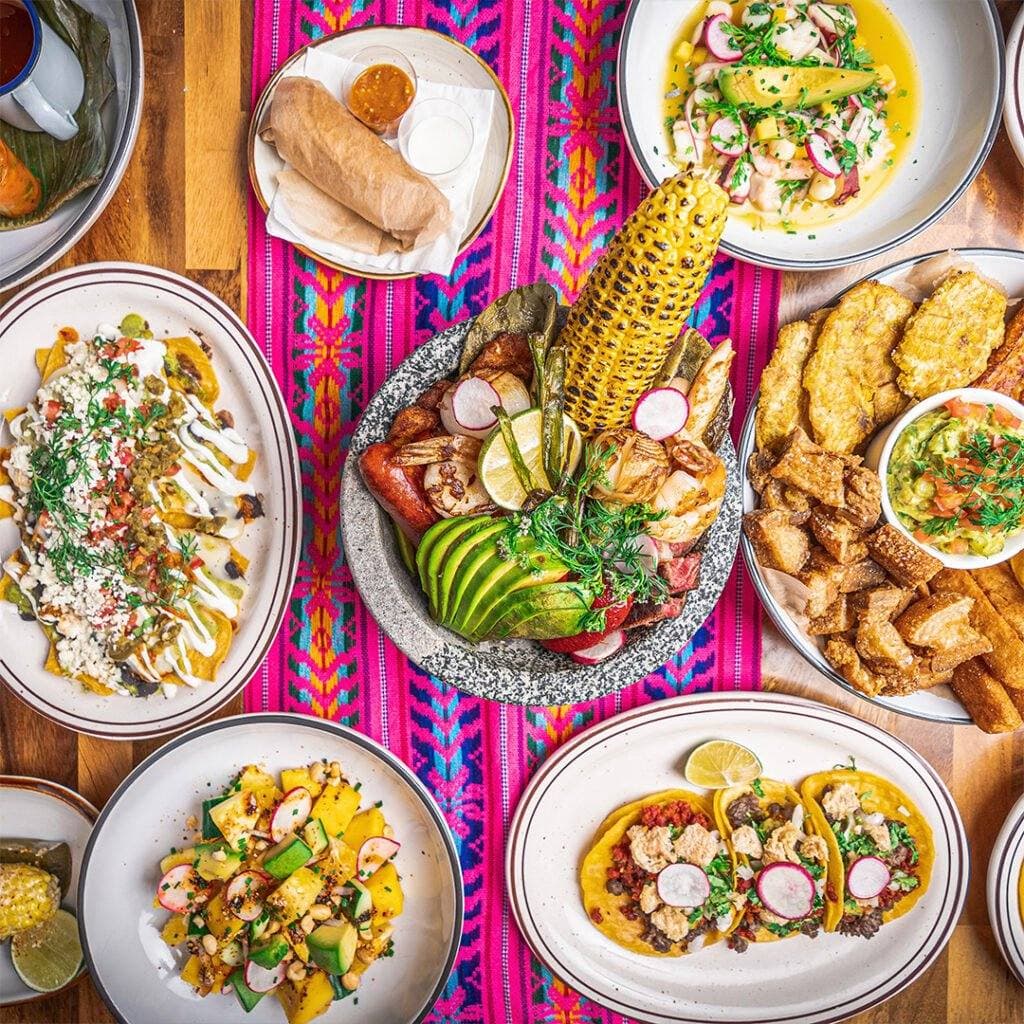
We don't cook the food of one Mexican state. We're a loud rooftop in Hell's Kitchen with a live DJ. Some of the menu follows the traditions above. Some is a New York party's idea of a good time, like the Red Velvet Chicken & Waffles at brunch. A few of our plates right now:
Our hours: Tuesday to Thursday 5pm to 11pm (last reservation 10pm), Friday 5pm to 3am, Saturday 12pm to 3am and Sunday 12pm to 9:30pm. Closed Mondays. See the full menu, or read about Mexican brunch dishes before you come on a weekend.
Mexican food questions
What is Mexican food?
The cooking of Mexico, built on corn, beans and chile, with pork, beef, wheat, rice and cheese added after the Spanish arrived. It changes a lot by region. UNESCO listed traditional Mexican cuisine as intangible cultural heritage in 2010.
What are the main ingredients in Mexican food?
Corn, beans and chile are the base, along with tomato, squash and avocado. Corn is usually treated with lime first, a step called nixtamalization, then ground for tortillas and tamales.
What is the most popular Mexican food?
Larousse Cocina says the taco is the most eaten antojito in Mexico. Rankings beyond that are mostly opinion, and they shift by region. Our chart of 16 tacos is a good place to start.
What's the difference between Mexican and Tex-Mex food?
Tex-Mex grew up in Texas among Mexican Americans. It leans harder on melted cheese and flour tortillas. Mexican cooking is the older, wider tradition, and most of its cheeses are fresh.
Is Mexican food spicy?
Often less than people expect, because much of the heat sits in the table salsas. Larousse describes those as something you dress the food with as you eat.
Do you have vegetarian Mexican food?
Yes, our menu has a vegetarian taco. Tell your server about any allergies when you order. See the menu.
Where can I eat Mexican food in Hell's Kitchen?
Cantina Rooftop is at 605 W 48th St, between 11th and 12th Avenue. It's about a 12-minute walk from the C/E at 50th Street. More about the restaurant.